
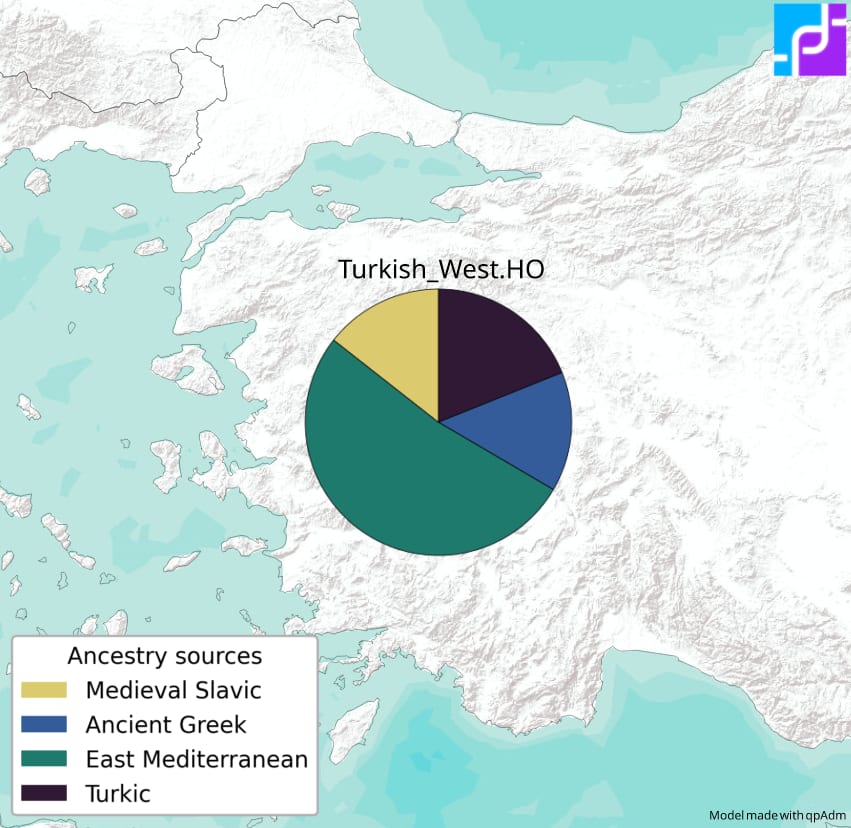
Modeling Overview#
All ancestry models were generated using qpAdm and replicated with Global25 and show strong overall model fit, indicating that the inferred ancestry proportions provide a reliable representation of population structure within the chosen framework.
qpAdm modeling shows that modern Anatolian Turks carry ancestry from multiple sources spanning several millennia. By comparing modern genomes against ancient populations, we can see how each period contributed to the overall genetic profile. Models were run using the v64 dataset from the Harvard Reich Lab
The Southern Arc and Bronze Age Anatolia#
The largest single body of ancient DNA for the region is the Southern Arc project, published as three papers by Lazaridis et al. in Science in 2022, covering more than seven hundred newly reported genomes from Anatolia, the Caucasus, the Balkans and the Levant. For Anatolia its central finding is continuity. From the Neolithic through the Chalcolithic and into the Bronze Age, the population of the peninsula kept its farmer foundation while absorbing ancestry from the east: a Caucasus and Iranian plateau related component that had spread across Anatolia by the Chalcolithic, and a smaller Levantine contribution in the south. Individuals from Hittite-period sites of the second millennium BC are, in the authors' models, essentially descendants of this Chalcolithic Anatolian population.
The point that surprised many readers is what the Bronze Age Anatolians lack. Yamnaya steppe ancestry, which reshaped Europe in the third millennium BC and is the usual genetic marker of Indo-European expansion, is nearly absent in Bronze Age Anatolia, even at sites where Hittite and other Anatolian Indo-European languages were spoken. Lazaridis et al. argue that the Anatolian branch of Indo-European arrived through the Caucasus with the eastern ancestry rather than with a steppe migration, an argument that is still debated but that rests on the genomes rather than against them. For the models in this post the practical consequence is simple: the Yamnaya related component in modern Anatolian Turks was not already present in the Bronze Age population and has to be explained by populations that entered the peninsula later, above all the Balkan and Greek groups of Antiquity and the Middle Ages that carried it.
Neolithic farmer & Yamnaya Ancestry#
The earliest major component in modern Anatolian Turks derives from Neolithic Anatolian farmers. This ancestry reflects the spread of early agricultural populations across Anatolia and represents the core local genetic foundation. Despite later admixture events, this Neolithic layer remains a significant part of the modern gene pool, illustrating the long-term presence of these early farming communities in the region.
Iron Age & Medieval Ancestry#
Subsequent historical periods added additional layers of ancestry:
-
Local and East Mediterranean populations such as the Hittites, Phrygians, Phoenicians, and many more, which mostly spread during the Roman era and the Byzantine period, contributed to the genetic makeup of Anatolia, reflecting the region's role as a crossroads of civilizations and its long history of cultural and genetic exchange.
-
Ancient Greek ancestry, which was present in Anatolia since the Bronze Age and became more widespread during the Hellenistic and Roman periods, contributed to the genetic landscape of modern Anatolian Turks. This reflects the historical interactions between Greek city-states and Anatolian populations, as well as the spread of Greek culture and people across the region.
-
Slavic ancestry, which entered Anatolia during the medieval period through migrations and interactions with Slavic populations in the Balkans, also contributed to the genetic diversity of modern Anatolian Turks. This admixture reflects the historical movements of Slavic peoples into the region and their interactions with existing populations, further shaping the genetic landscape of modern Anatolian Turks.
-
Turkic migrations from Central Asia during the medieval period introduced additional genetic diversity, contributing to the modern Turkish gene pool. This admixture reflects the historical movements of Turkic peoples into Anatolia and their interactions with existing populations, further shaping the genetic landscape of modern Anatolian Turks.
From Byzantium to the Seljuks#
At the end of Antiquity, Anatolia was the Greek-speaking heartland of the Byzantine Empire, and its population was the product of the layers described above plus the Roman-era mixing that connected it to the Balkans, the Aegean and the Levant. The Turkic presence begins with the Seljuk victory at Manzikert in 1071 and the settlement of Oghuz Turkmen groups across the central plateau in the following decades; the Sultanate of Rum, the Turkmen principalities of the thirteenth and fourteenth centuries and finally the Ottoman state completed the political transformation.
The genetic record shows this was a change of language and rule far more than a change of population. Incoming Turkic groups were numerous enough to leave a clear East Eurasian signal but small relative to the millions of Anatolians already there, and they absorbed the existing population rather than replacing it. This is why modern Anatolian Turks model overwhelmingly as descendants of the Byzantine-era inhabitants with a Central Asian layer on top, and why they sit closest in genetic distance to their non-Turkic neighbours in the Aegean, Caucasus and Levant rather than to any Central Asian Turkic population.
How large is the East Eurasian share?#
Published estimates for the East Eurasian, Central Asian derived component in Anatolian Turks cluster in the range of roughly 5 to 15 percent, with most genome-wide studies placing the average near 10 percent. Alkan et al. 2014 reported a Central Asian contribution of about 9 to 15 percent from whole-genome sequences; Yunusbayev et al. 2015, in a survey of Turkic-speaking populations across Eurasia, found Anatolian Turks among the Turkic groups with the smallest East Asian related share; and the Southern Arc papers describe modern Turks as carrying a minor Central Asian component over a base that is otherwise Byzantine Anatolian. Earlier estimates based on small marker sets ran higher, some above 20 percent, and are generally read today as upper bounds rather than as measurements.
The share is not uniform. In the published samples it tends to be somewhat higher in central and eastern Anatolia, where Turkmen settlement was densest, and lower along the Aegean and Marmara coasts and in the far south-east, where Greek, Armenian and Kurdish neighbours contribute more of the local profile, though the gradient is gentle and the sample sizes per region are small. Individual variation is wide: two people from the same province can differ by several percentage points, and a single qpAdm model with a national average as target hides that spread. Treat the national figure as a centre, not a rule.
Global25 models provide very similiar results to qpadm modeling, with the same major ancestry components and similar proportions. This consistency across different modeling approaches strengthens the confidence in the inferred ancestry proportions and the overall conclusions about the genetic makeup of modern Anatolian Turks.
Modern Anatolian Turks are a genetically complex population with ancestry from multiple sources spanning several millennia. The core local ancestry derives from Neolithic Anatolian farmers, while subsequent historical periods added layers of ancestry from local and East Mediterranean populations, ancient Greeks, Slavic migrations, and Turkic migrations. This intricate genetic tapestry reflects the rich history of Anatolia as a crossroads of civilizations and the dynamic interactions between diverse populations over time.
Frequently asked questions#
Are Anatolian Turks mostly Central Asian in ancestry?#
No. The Central Asian derived, East Eurasian component is a minority, around a tenth of the genome in most estimates. The large majority of Anatolian Turkish ancestry descends from the populations that lived in Anatolia before the Seljuk period: Neolithic farmers, Bronze Age Anatolians with Caucasus related ancestry, and the Greek, Balkan and Near Eastern populations of Antiquity and the Byzantine centuries.
Did the Hittites carry steppe ancestry?#
According to the Southern Arc genomes, essentially not. Bronze Age Anatolian individuals, including those from Hittite-period contexts, model as Chalcolithic Anatolians with Caucasus and Iranian related ancestry and nearly no Yamnaya component. The steppe related ancestry seen in modern Turks arrived later, largely through Balkan and Greek populations.
Why do Global25 and qpAdm agree on the models here?#
Because both are reading the same underlying signal. qpAdm tests a proposed set of sources with a p-value; Global25 fits a coordinate against a source panel by distance. When a model is right, the two should give similar proportions, and here they do. When they disagree, the qpAdm side is the one that can actually reject a model, which is why we report it first. See qpAdm vs Global25.
References#
- Lazaridis, I. et al. (2022). The genetic history of the Southern Arc: A bridge between West Asia and Europe. Science 377, eabm4247. https://doi.org/10.1126/science.abm4247
- Alkan, C. et al. (2014). Whole genome sequencing of Turkish genomes reveals functional private alleles and impact of genetic interactions with Europe, Asia and Africa. BMC Genomics 15, 963. https://doi.org/10.1186/1471-2164-15-963
- Yunusbayev, B. et al. (2015). The Genetic Legacy of the Expansion of Turkic-Speaking Nomads across Eurasia. PLoS Genetics 11, e1005068. https://doi.org/10.1371/journal.pgen.1005068


