
Notable Matches · Deep time
The Ranis Pioneers
The Ranis Pioneers (c. 45,000–41,000 BCE · Ilsenhöhle, Ranis, Germany): published ancient DNA, 9 sequenced genomes, and how close your own Global25 coordinates come — free with every Ancestrify G25 report.
The dossier
- Catalog tier
- Deep time
- Period
- c. 45,000–41,000 BCE
- Found
- Ilsenhöhle, Ranis, Germany
- Sequenced genomes
- 9 (RNI081, RNI006, RNI085, RNI004, RNI013.SG, RNI010, RNI087, RNI080, RNI012)
Who they were
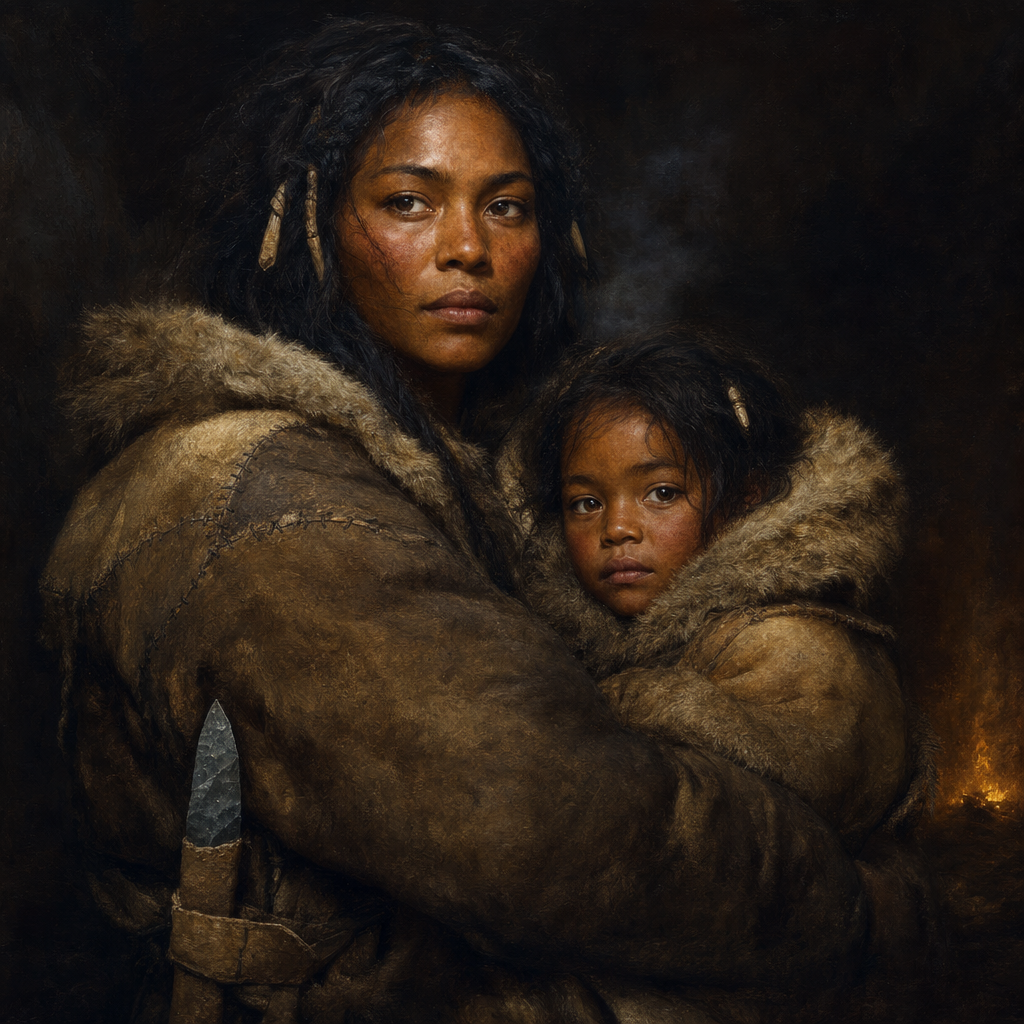
In a cave beneath the castle rock of Ranis, small bands of the very first Homo sapiens in northern Europe made brief camps in a subarctic world — winters some fifteen degrees colder than today — hunting reindeer, horse and woolly rhinoceros, and sharing the cave, in turns, with hibernating cave bears and denning hyenas. Their finely worked leaf-shaped stone points had long been credited to Neanderthals; their bones proved otherwise. Among the six individuals identified were a mother and her small daughter, and their genomes reach further still: a woman buried 230 kilometres away in Czechia was their distant cousin. They belonged to a tiny pioneer population of a few hundred, among the earliest branches of humanity outside Africa — one that vanished without descendants, leaving only these traces of the boldest migration of its age.
The genome-wide data behind this entry was published in Earliest modern human genomes constrain timing of Neanderthal admixture.
How your distance is measured
Every Ancestrify Global25 report includes the free Notable Matches lens: your coordinates are compared to every sequenced member of every catalog entry, and the distance to the closest member is reported — a Euclidean distance in the same 25-dimensional space the Distance lens uses. Because these are a small group of real individuals, not a population average, distances naturally run larger than population distances — that is expected, not a poor result. And one thing is never claimed: a small distance means similar ancestry composition, not that the Ranis Pioneers are your ancestor. See how it looks in the live demo or read about the full G25 analysis.
Questions
Who were the Ranis Pioneers?
The Ranis Pioneers (c. 45,000–41,000 BCE, Ilsenhöhle, Ranis, Germany) are one of the Deep time entries in our Notable Matches catalog, represented by 9 sequenced ancient genomes published in the study "Earliest modern human genomes constrain timing of Neanderthal admixture".
What does "matching" the Ranis Pioneers mean?
Your Global25 coordinates are compared to the entry's sequenced members and the distance to the closest one is reported — a Euclidean distance in the same 25-dimensional reference space the Distance lens uses. A notable entry is one person or one small burial group, not a population average, so distances naturally run larger than population distances.
Are they my ancestor?
No — and no DNA test can show that. A small distance means your genome sits near theirs in a shared reference space: similar ancestry composition, not descent. Ancestrify never claims a notable individual is your ancestor or relative.
How do I see my own distance to the Ranis Pioneers?
Notable Matches is a free lens on every Ancestrify Global25 report — never sold separately. Order the G25 analysis (29.99 EUR), and your report ranks your coordinates against the full catalog, with a portrait, dossier and map for every entry. The public demo shows the lens with example data.
More from the catalog
The catalog holds every published entry across three tiers — browse the full Notable Matches directory. Nearby entries:
Ust'-Ishim Manc. 43,000 BCE
The Bacho Kiro Pioneersc. 43,000 BCE
The Zlatý Kůň Womanc. 43,000 BCE
Tianyuan Manc. 38,000 BCE
Oase 1c. 38,000 BCE
Kostenki Manc. 36,000 BCE
The Peștera Muierii Womanc. 33,000 BCE
Goyet Q116-1c. 33,000 BCE
The Salkhit Womanc. 32,000 BCE
The Sunghir Burialc. 32,000 BCE
The Dolní Věstonice Triple Burialc. 29,000 BCE
Mal'ta Boyc. 22,500 BCE