
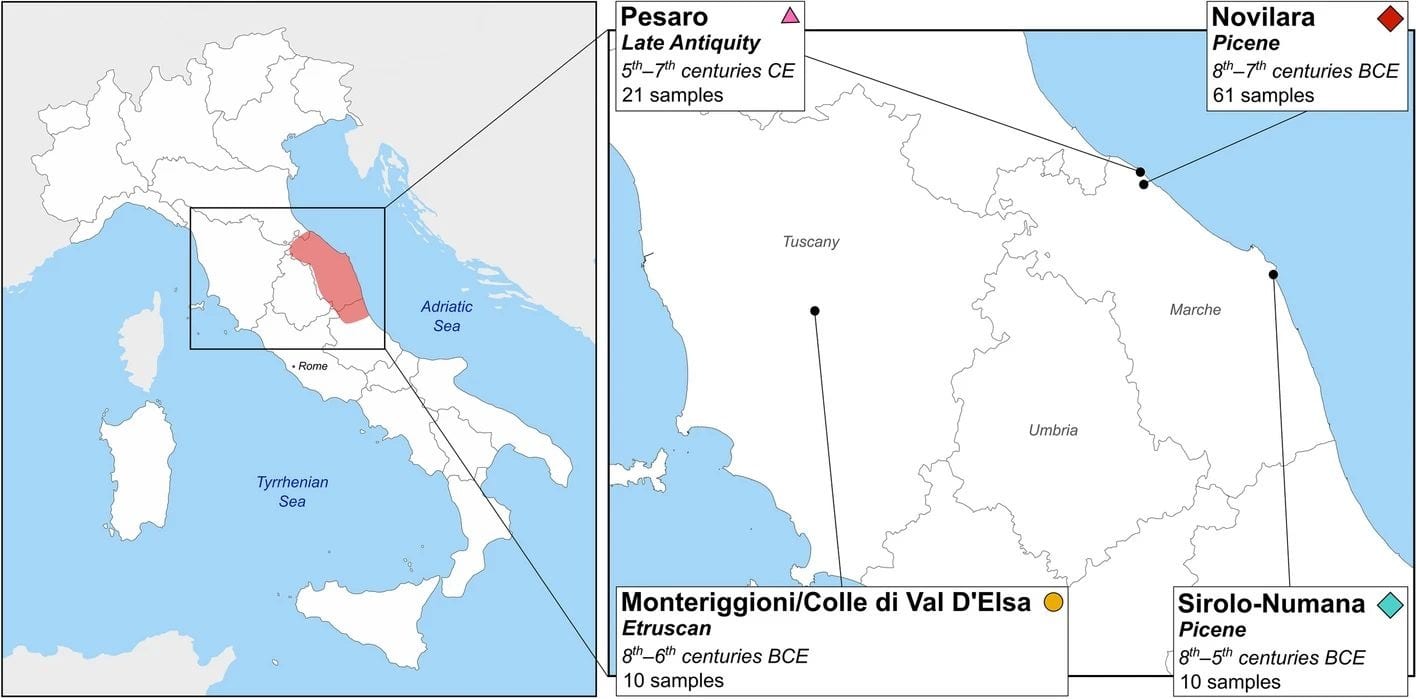
Recent ancient DNA research provides the first comprehensive view of the Picenes (Picentes), an Iron Age population of Central Italy along the Middle Adriatic coast. This study sheds light on their paternal lineages, ancestral composition, and genetic relationships with neighboring populations.
Who the Picenes were#
The Picenes occupied the Adriatic side of the Apennines, in what is now Marche and the northern part of Abruzzo, from roughly the ninth to the third century BC. Their culture is known almost entirely from cemeteries: the great necropolis of Novilara near Pesaro, discovered in 1873, together with sites such as Numana, Matelica, Fermo and Campovalano in the Abruzzo hills. Men were buried with weapons in nearly every grave, women with heavy ornaments of bronze and amber, and both with imports that show the reach of Adriatic trade, from Greek pottery to Egyptian faience. The famous Novilara stele carries a naval battle of oared ships and an inscription in a language that has still not been read. Roman sources counted the Picenes among the Italic peoples; Rome absorbed the region in 268 BC after defeating the Picentes and deported part of the population to the Gulf of Salerno.
Their language belongs to the Italic family, though the South Picene inscriptions differ clearly from the Novilara text, and archaeologists have long debated how far the culture was shaped by contact across the Adriatic with the Illyrian coast. That question is exactly what the genomes were able to test.
What the 2024 genomes showed#
The study behind this post is Ravasini et al. 2024, published in Genome Biology, which sequenced individuals from Novilara and neighbouring Picene sites dating to the Iron Age, together with later samples from the same region into the Roman period. The authors report that the Picenes as a whole carry a largely Italic Iron Age profile: the same combination of Neolithic farmer, steppe-related and hunter-gatherer ancestry seen in other Iron Age populations of central Italy, with proportions that overlap those of their contemporaries.
On top of that shared base the study attributes two kinds of additional input. A subset of individuals, concentrated in the northern part of the sampled area, shows a pull toward Central Europe and the western Balkans, which the authors read as the genetic side of the trans-Adriatic contact the archaeology had already suggested. A smaller number of individuals stand out for eastern Mediterranean or Near Eastern related ancestry, including one man whose paternal lineage points to the Near East, buried at Novilara in the same manner as everyone else. The authors present these as individual outliers within a cohesive community rather than as evidence of a separate incoming population.
The Roman-period samples from the same region tell the second half of the story: the shift toward eastern Mediterranean ancestry that has been documented in Rome itself is visible on the Adriatic coast too, which the study describes as the demographic legacy of the Roman Empire in central Italy.
Paternal Lineages#
Analysis of Picene male individuals identifies two main Y-chromosome haplogroups. R1b‑M269 / L23 is the dominant lineage, linked to Steppe-related ancestry and widespread across Bronze Age and Iron Age Europe. Subclades suggest connections to both Central and Western European populations. J2‑M172 / M12, including subclades like J2b‑L283, indicates links with Western Balkan and Illyrian populations. These two haplogroups represent the documented Picene paternal diversity in the dataset; other lineages were not reported.
Ancestral Composition#
Genome-wide analysis reveals that the Picenes' ancestry derives from three primary components: Western Steppe Herders, Western Hunter Gatherers, and European Neolithic Farmers.
Admixture models indicate that the Picenes carry a high proportion of combined Yamnaya and Anatolian Neolithic ancestry, with minor contributions from WHG. Their profile is broadly consistent with other Iron Age Central Italian populations, while subtle shifts reflect regional specificity.
Regional Variation#
When modeled alongside Western Balkan, Northern, and local Italic proxies, the Picenes reveal subtle regional variation in their ancestry. Northern Picenes show stronger connections to Western Balkan and northern/Celtic-associated populations, reflecting greater influence from trans-Adriatic interactions, while southern Picenes appear more closely aligned with local Italic groups, suggesting stronger continuity within Central Italy. Across the region, all Picenes maintain a balance of external influences and local ancestry, placing them in an intermediate genetic position distinct from both Etruscans and fully northern populations.
Genetic Position in Iron Age Italy#
The genetic evidence positions the Picenes as a dynamic population within Iron Age Italy. They were neither fully aligned with northern/Celtic nor entirely with local Italic groups. Instead, they combined external influences from across the Adriatic with regional continuity, resulting in a distinct genetic signature. PCA and clustering analyses further confirm that Picenes occupy an intermediate space between Central European, Balkan, and Italian populations, with subtle north-south differences reflecting local demographic history.
Etruscans and Latins compared#
Two earlier studies frame the Picene result. Posth et al. 2021 (Science Advances) sequenced Etruscans from Tuscany and Lazio and found a population that was, despite its non-Indo-European language, genetically much like its Italic neighbours: local Neolithic-derived ancestry with a substantial steppe-related component that had arrived in the Bronze Age. Antonio et al. 2019 (Science) did the same for Iron Age Latins around Rome and reached a similar conclusion, adding that Iron Age Latium already showed early contacts with the eastern Mediterranean.
Placed beside those two, the Picenes are neither Etruscan nor Latin but clearly part of the same Iron Age Italian gene pool. Where they differ is at the edges: the Adriatic contact signal is stronger among the Picenes than in Tuscany or Latium, and it is stronger in the north of Picene territory than in the south. The north to south gradient described above is therefore a Picene detail on top of a central Italian foundation, not a separate ancestry.
The Picenes in Ancestrify's catalog#
The Picene individuals from this study are part of our ancient reference data under the catalog source Italic Iron Age (900 - 500 BC), which sits in the Classical Antiquity era. Its samples carry ids beginning with PN, the excavation prefix for Novilara, so a customer with central Italian or Adriatic ancestry can see whether their closest Iron Age Italian matches come from the Tyrrhenian or the Adriatic side of the peninsula, and a qpAdm model can use the Picenes as a source alongside other Iron Age populations.
Frequently asked questions#
Were the Picenes Illyrians who crossed the Adriatic?#
The genomes say no, at least not as a population. The Picenes are overwhelmingly of central Italian Iron Age ancestry. The western Balkan signal is real but partial and concentrated in some northern individuals, consistent with steady contact and some movement across the Adriatic rather than with a migration that founded the culture.
How do the Picenes differ from the Etruscans?#
Very little at the level of genome-wide ancestry: both are Iron Age Italian populations built on Neolithic farmer and steppe-related ancestry. The differences are a slightly stronger Balkan pull among the Picenes and the appearance of eastern Mediterranean ancestry in a few individuals. Language and material culture separate the two far more sharply than DNA does.
Can I find out whether I match the Picene samples?#
Yes. The Novilara individuals are in our reference data as the Italic Iron Age (900 - 500 BC) source, so an Ancient Matches scan or a qpAdm model can show how a genome relates to them compared with other Iron Age Italian and Balkan populations.
References#
- Genome Biology (2024). The genomic portrait of the Picene culture provides new insights into the Italic Iron Age and the legacy of the Roman Empire in Central Italy. Springer Nature. https://link.springer.com/article/10.1186/s13059-024-03430-4
- Posth, C. et al. (2021). The origin and legacy of the Etruscans through a 2000-year archeogenomic time transect. Science Advances 7, eabi7673. https://doi.org/10.1126/sciadv.abi7673
- Antonio, M. L. et al. (2019). Ancient Rome: A genetic crossroads of Europe and the Mediterranean. Science 366, 708 to 714. https://doi.org/10.1126/science.aay6826


