
Ancestry populations · Hunter Gatherer and Neolithic Farmer
Native American
The founding population of the Americas, descended from Ancient Beringians who crossed from Siberia and diversified from Alaska to Patagonia. One of the 13 curated source populations in the Hunter Gatherer and Neolithic Farmer era of the Ancestrify qpAdm ancient-DNA analysis.
Who they were
- Period
- 15000 – 1500 BC
- Era in the analysis
- Hunter Gatherer and Neolithic Farmer
- Region
- The Americas
- Role in the model
- Source (left) population — a reference qpAdm tests against
The first peoples of the Americas descend from a population that formed in north-east Siberia and Beringia from a mixture of Ancient North Eurasian and East Asian lineages, and entered the continent as the ice sheets retreated. Ancient genomes from the Anzick child in Montana, from Ancient Beringians in Alaska and from Lagoa Santa in Brazil show a rapid split into northern and southern branches followed by an extraordinarily fast spread to the southern tip of South America (Raghavan et al. 2015; Moreno-Mayar et al. 2018; Posth et al. 2018).
This ancestry is the indigenous heritage of every population from the Arctic to Tierra del Fuego, and it is present in large measure across Latin America through colonial-era admixture. It is genetically the most isolated source in the era, sharing a deep Siberian connection with the Northeast Asian source and, through the Ancient North Eurasians, a fainter one with the Eastern Hunter Gatherer. In the model that isolation makes it one of the cleanest signals to detect: a genuine weight is rarely confused with anything else.
In Ancestrify's qpAdm service, Native American is a source in the "Hunter Gatherer and Neolithic Farmer" era. The report shows its weight with a standard error and a Z-score, so you can see not only how much of the model it carries but how confidently that share is separated from zero, and a model that cannot support it is rejected rather than published. A weight here is typically the most confidently separated of the era's sources, and the Z-score will usually show it.
Y haplogroups Q-M3 and C2, and the mtDNA founding lineages A2, B2, C1, D1 and X2a, characterise these samples. A haplogroup alone is never evidence of a share.
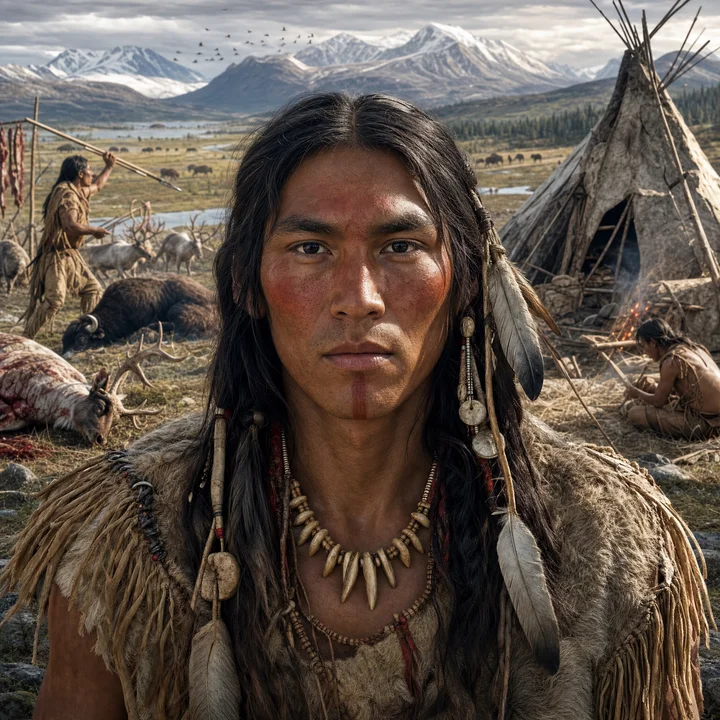
In your reportArtwork is an AI-generated artistic interpretation informed by the archaeological record — not documentary evidence.Descends from populations that migrated from northeast Asia into the Americas via the Beringia land bridge during the late Pleistocene. Ancient DNA from the ~11,500-year-old Upward Sun River infants in Alaska revealed the first founding population of Native Americans, distinct from all known Asian groups. Most Indigenous Americans trace their ancestry to a single founding population (First Americans), though at least three separate streams of Asian gene flow contributed to the genetic diversity of the Americas. The initial peopling followed a rapid southward coastal expansion with sequential population splits and limited subsequent gene flow, particularly in South America. All ancient individuals in the Americas, except later-arriving Arctic peoples, are more closely related to contemporary Indigenous Americans than to any population elsewhere.
Where this population sits in the model
The Ancestrify qpAdm analysis models your genome once per era. The Hunter Gatherer and Neolithic Farmer era has 13 curated source populations, and Native American is one of them: every candidate model for that era is a combination of these sources, tested against a fixed set of outgroup populations, and only a model that passes the statistical fit check is published — with a p-value, and a standard error on every proportion.
A reference, not a verdict: every population on this page is a source the model tests your genome against — a well-sampled point in ancient genetic space that a mixture of ancestries can be expressed in terms of. A weight on it means your genome is well described as partly resembling those people; it is never a statement that they, specifically, were your ancestors, and a population that fits well is not the only one that could.
Read how the method works on the qpAdm analysis page, or the definitions in the glossary.
Model it yourself for free
The Ancestrify Lab runs in your browser, with no account. Paste a Global25 row into an admixture calculator that covers the Hunter Gatherer and Neolithic Farmer era, rank the closest ancient populations in the distance tool, or run f4, qpWave and qpAdm on the public panel in the AdmixTools 2 workbench. These are Global25 fits and exploratory statistics, not the formal qpAdm model of the paid analysis.
Questions
Who were the Native American (15000 – 1500 BC)?
Native American is one of the 13 curated source populations in the Hunter Gatherer and Neolithic Farmer era of the Ancestrify qpAdm analysis: a group of published ancient genomes from one archaeological context, pooled as a single reference the model can test your genome against.
Does Native American in my result mean they were my ancestors?
No. A source population is a reference the model tests against, never a statement about who your ancestors were. A coefficient on this source means the ancestry those burials represent helps explain your genome to within statistical noise — similar ancestry composition, not descent from those individuals. Ancestrify never claims a population is your ancestor.
What does a Native American percentage in a qpAdm model mean?
qpAdm estimates the mixture proportions that best explain your genome as a combination of the chosen sources, given a fixed set of outgroup (right) populations, and reports a p-value for whether the model is statistically acceptable together with a standard error for every proportion. The percentage is that estimated share, with its uncertainty published beside it.
How do I get a qpAdm model that uses Native American?
Order the Ancestrify qpAdm analysis (€29.99, one-time) and upload the raw file you already have from a consumer test. Your genome is merged into the AADR reference panel and modelled across both eras; each era's model is built from that era's source populations, so a model for the Hunter Gatherer and Neolithic Farmer era draws on Native American where it improves the fit.
Can I model Native American ancestry for free first?
Yes. The Ancestrify Lab runs Global25 admixture calculators, a nearest-populations distance tool and an AdmixTools 2 workbench in your browser with no account, and several calculators cover the Hunter Gatherer and Neolithic Farmer era. Those are G25 fits, not formal qpAdm models — the paid analysis is the one with a p-value.
More populations from the Hunter Gatherer and Neolithic Farmer era
Browse the full directory of source populations, or continue with another population from the same era:
Anatolian Neolithic Farmer8500 – 6000 BC
Ancestral South Indian10000 – 2000 BC
Caucasian Hunter Gatherer13000 – 7000 BC
Eastern Hunter Gatherer12000 – 5000 BC
Iberomaurusian15000 – 8000 BC
Iranian Neolithic Farmer8000 – 5000 BC
Natufian12000 – 8000 BC
North African Farmer5200 – 4000 BC
Northeast Asian6000 – 2000 BC
Sub Saharan African
Western Hunter Gatherer12000 – 6000 BC
Western Steppe Herder5000 – 2800 BC