
Ancestry populations · Hunter Gatherer and Neolithic Farmer
North African Farmer
Neolithic farmers of Morocco who blended the indigenous Iberomaurusian lineage with newcomers from Iberia and the Levant. One of the 13 curated source populations in the Hunter Gatherer and Neolithic Farmer era of the Ancestrify qpAdm ancient-DNA analysis.
Who they were
- Period
- 5200 – 4000 BC
- Era in the analysis
- Hunter Gatherer and Neolithic Farmer
- Region
- Maghreb, north-west Africa
- Role in the model
- Source (left) population — a reference qpAdm tests against
The Neolithic farmers of the Maghreb represent the arrival of agriculture in north-west Africa and the first mixing of its ancient inhabitants with populations from across the sea. Early Neolithic individuals from Ifri n'Amr or Moussa in Morocco were still overwhelmingly descended from the local Iberomaurusian lineage, while Late Neolithic people from Kelif el Boroud carried substantial European farmer ancestry that had crossed from Iberia, together with an eastern Mediterranean stream from the Levant (Fregel et al. 2018; Simões et al. 2023).
This layered population is the direct forerunner of the Berber-speaking peoples and of the deep ancestry of the Maghreb today, beneath later Phoenician, Roman, Arab and sub-Saharan contributions. In the model it sits between the Iberomaurusian source it descends from and the Anatolian farmer source that entered through Iberia, and it is the most useful North African reference for genomes whose heritage lies in Morocco, Algeria or Tunisia.
In Ancestrify's qpAdm service, North African Farmer is a source in the "Hunter Gatherer and Neolithic Farmer" era. The report shows its weight with a standard error and a Z-score, so you can see not only how much of the model it carries but how confidently that share is separated from zero, and a model that cannot support it is rejected rather than published. Because it is itself a mixture of two other sources in the era, the model may prefer it or its components depending on the genome, and the standard errors show how confidently it chose.
Y haplogroups E-M81 and E-M78 and mtDNA U6, M1, K1 and T2 are reported in these samples. A haplogroup alone is never evidence of a share.
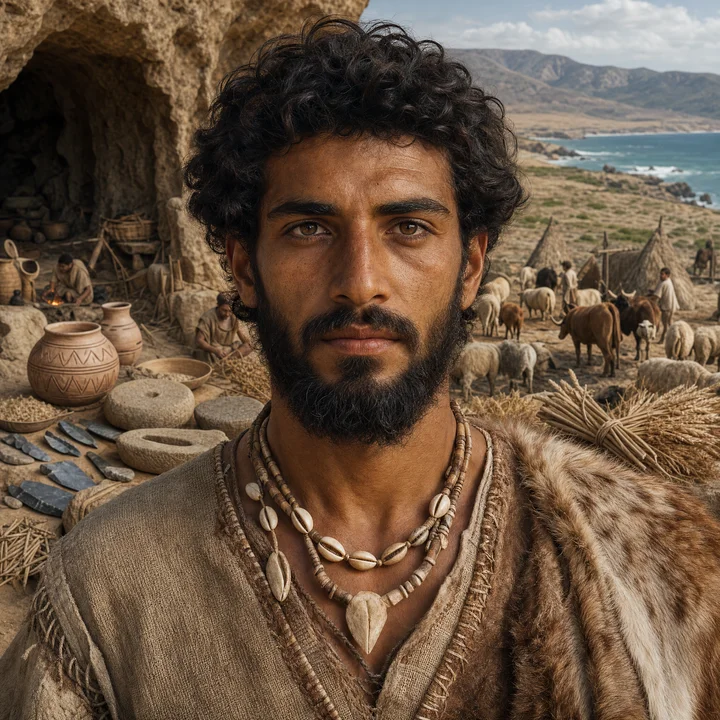
In your reportArtwork is an AI-generated artistic interpretation informed by the archaeological record — not documentary evidence.Encompasses the prehistoric agricultural populations of the Maghreb whose transition to farming (~7,400 years ago) involved multiple migration waves from Iberia and the Levant mixing with indigenous Iberomaurusian-descended foragers. The earliest Neolithic contexts show predominantly European Neolithic ancestry, followed by a Middle Neolithic influx of Levantine pastoralist ancestry. Indigenous North African lineages, traceable through Iberomaurusian specimens at Taforalt (~23,000 BP) and Afalou (~15,000 BP), demonstrate at least 20,000 years of genetic continuity in the region. By the Late Neolithic, European, Levantine, and local ancestries had blended into a distinctive North African genetic profile. This composite ancestry forms a key baseline for understanding subsequent Phoenician, Roman, and Arab-era demographic changes across the Maghreb.
Where this population sits in the model
The Ancestrify qpAdm analysis models your genome once per era. The Hunter Gatherer and Neolithic Farmer era has 13 curated source populations, and North African Farmer is one of them: every candidate model for that era is a combination of these sources, tested against a fixed set of outgroup populations, and only a model that passes the statistical fit check is published — with a p-value, and a standard error on every proportion.
A reference, not a verdict: every population on this page is a source the model tests your genome against — a well-sampled point in ancient genetic space that a mixture of ancestries can be expressed in terms of. A weight on it means your genome is well described as partly resembling those people; it is never a statement that they, specifically, were your ancestors, and a population that fits well is not the only one that could.
Read how the method works on the qpAdm analysis page, or the definitions in the glossary.
Model it yourself for free
The Ancestrify Lab runs in your browser, with no account. Paste a Global25 row into an admixture calculator that covers the Hunter Gatherer and Neolithic Farmer era, rank the closest ancient populations in the distance tool, or run f4, qpWave and qpAdm on the public panel in the AdmixTools 2 workbench. These are Global25 fits and exploratory statistics, not the formal qpAdm model of the paid analysis.
Questions
Who were the North African Farmer (5200 – 4000 BC)?
North African Farmer is one of the 13 curated source populations in the Hunter Gatherer and Neolithic Farmer era of the Ancestrify qpAdm analysis: a group of published ancient genomes from one archaeological context, pooled as a single reference the model can test your genome against.
Does North African Farmer in my result mean they were my ancestors?
No. A source population is a reference the model tests against, never a statement about who your ancestors were. A coefficient on this source means the ancestry those burials represent helps explain your genome to within statistical noise — similar ancestry composition, not descent from those individuals. Ancestrify never claims a population is your ancestor.
What does a North African Farmer percentage in a qpAdm model mean?
qpAdm estimates the mixture proportions that best explain your genome as a combination of the chosen sources, given a fixed set of outgroup (right) populations, and reports a p-value for whether the model is statistically acceptable together with a standard error for every proportion. The percentage is that estimated share, with its uncertainty published beside it.
How do I get a qpAdm model that uses North African Farmer?
Order the Ancestrify qpAdm analysis (€29.99, one-time) and upload the raw file you already have from a consumer test. Your genome is merged into the AADR reference panel and modelled across both eras; each era's model is built from that era's source populations, so a model for the Hunter Gatherer and Neolithic Farmer era draws on North African Farmer where it improves the fit.
Can I model North African Farmer ancestry for free first?
Yes. The Ancestrify Lab runs Global25 admixture calculators, a nearest-populations distance tool and an AdmixTools 2 workbench in your browser with no account, and several calculators cover the Hunter Gatherer and Neolithic Farmer era. Those are G25 fits, not formal qpAdm models — the paid analysis is the one with a p-value.
More populations from the Hunter Gatherer and Neolithic Farmer era
Browse the full directory of source populations, or continue with another population from the same era:
Anatolian Neolithic Farmer8500 – 6000 BC
Ancestral South Indian10000 – 2000 BC
Caucasian Hunter Gatherer13000 – 7000 BC
Eastern Hunter Gatherer12000 – 5000 BC
Iberomaurusian15000 – 8000 BC
Iranian Neolithic Farmer8000 – 5000 BC
Native American15000 – 1500 BC
Natufian12000 – 8000 BC
Northeast Asian6000 – 2000 BC
Sub Saharan African
Western Hunter Gatherer12000 – 6000 BC
Western Steppe Herder5000 – 2800 BC