
Ancestry populations · Classical Antiquity
Phoenician
The Iron Age Levantine seafarers of Tyre, Sidon and Byblos, direct heirs of the Canaanites, who founded colonies across the Mediterranean. One of the 27 curated source populations in the Classical Antiquity era of the Ancestrify qpAdm ancient-DNA analysis.
Who they were
- Period
- 850 – 50 BC
- Era in the analysis
- Classical Antiquity
- Region
- Lebanese coast, the Levant
- Role in the model
- Source (left) population — a reference qpAdm tests against
The Phoenicians were the Iron Age inhabitants of the Lebanese coast — Tyre, Sidon, Byblos and Arwad — whose ships, alphabet and colonies reshaped the Mediterranean. Ancient genomes from Lebanon show that they were the direct descendants of the Bronze Age Canaanites, a population of Natufian-related Levantine ancestry with a substantial Iranian- or Caucasus-related component, that changed little through the Iron Age and Persian periods (Haber et al. 2017; Haber et al. 2020). Genomes from the colonies show, by contrast, that the Punic world abroad drew far more on local populations than on Levantine settlers (Fernandes et al. 2020).
This ancestry is the core of present-day Lebanese and a substantial layer across the Levant, Cyprus and among Jewish and Levantine Christian communities; in the western Mediterranean its trace is small and concentrated in Sardinia, Sicily, Ibiza and the Tunisian coast. In the model it is the pre-Roman Levantine pole, distinct from the Eastern Mediterranean source in lacking the Aegean and Anatolian admixture of the Roman centuries.
In Ancestrify's qpAdm service, Phoenician is a source in the "Classical Antiquity" era. The report shows its weight with a standard error and a Z-score, so you can see not only how much of the model it carries but how confidently that share is separated from zero, and a model that cannot support it is rejected rather than published. Its weight against the Eastern Mediterranean source describes how much of a Levantine genome the model attributes to the Iron Age population rather than to the Roman-era one, and the two related references may be hard to separate.
Y haplogroups J2, J1 and E1b1b, and mtDNA H, K, J and HV, are common in these samples. A haplogroup alone is never evidence of a share.
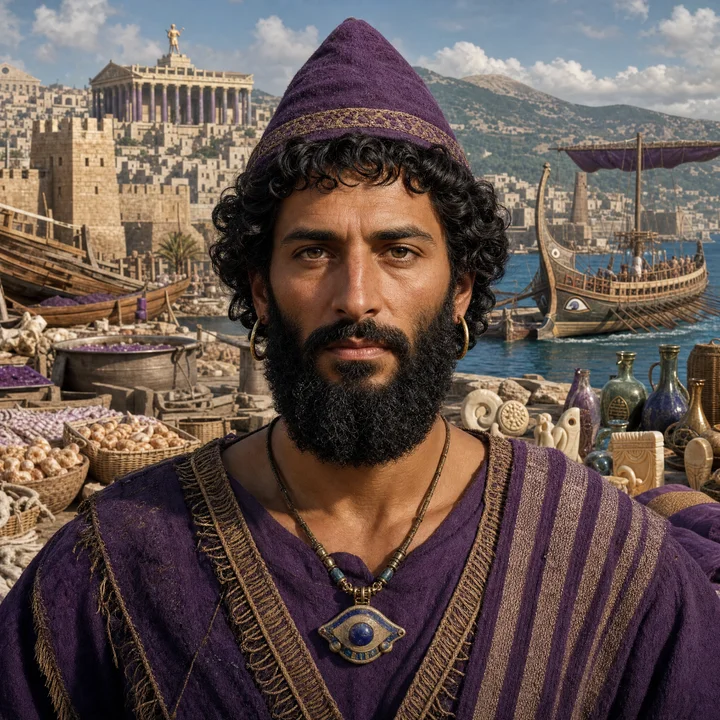
In your reportArtwork is an AI-generated artistic interpretation informed by the archaeological record — not documentary evidence.The seafaring Canaanite people of the Iron Age Levantine coast (~1500–300 BCE) who established a vast trading network and colonial settlements across the Mediterranean, including Carthage, western Sicily, Sardinia, and Iberia. Archaeogenomic studies show that despite strong cultural, linguistic, and religious continuity between the Levantine homeland and western settlements, Levantine Phoenicians made surprisingly little genetic contribution to Punic colonial populations. Western Phoenician-associated communities instead derived most of their ancestry from local Mediterranean populations genetically similar to ancient Sicilians and Aegeans. Bronze Age Levantine populations, the ancestral pool of Phoenicians, carried a mixture of local Natufian-related, Anatolian farmer, and Iranian/Caucasus-related ancestries. Phoenician cultural expansion thus functioned more as a franchise model of cultural transmission than as large-scale colonization by Levantine settlers.
Where this population sits in the model
The Ancestrify qpAdm analysis models your genome once per era. The Classical Antiquity era has 27 curated source populations, and Phoenician is one of them: every candidate model for that era is a combination of these sources, tested against a fixed set of outgroup populations, and only a model that passes the statistical fit check is published — with a p-value, and a standard error on every proportion.
A reference, not a verdict: every population on this page is a source the model tests your genome against — a well-sampled point in ancient genetic space that a mixture of ancestries can be expressed in terms of. A weight on it means your genome is well described as partly resembling those people; it is never a statement that they, specifically, were your ancestors, and a population that fits well is not the only one that could.
Read how the method works on the qpAdm analysis page, or the definitions in the glossary.
Model it yourself for free
The Ancestrify Lab runs in your browser, with no account. Paste a Global25 row into an admixture calculator that covers the Classical Antiquity era, rank the closest ancient populations in the distance tool, or run f4, qpWave and qpAdm on the public panel in the AdmixTools 2 workbench. These are Global25 fits and exploratory statistics, not the formal qpAdm model of the paid analysis.
Albanian Calculator5 sources
North Macedonian calculator5 sources
Montenegrin Calculator5 sources
Serbian Calculator6 sources
Bosnian Calculator5 sources
Croatian Calculator6 sources
Slovenian Calculator6 sources
Romanian Calculator4 sources
Moldovan Calculator5 sources
Bulgarian Calculator5 sources
Classic Greek Mainland & Arvanite Calculator5 sources
Greek Anatolia & Pontus Calculator5 sources
Greek Macedonia & Thrace Calculator5 sources
Turkish Black Sea Calculator4 sources
Turkish Calculator5 sources
Central Italian Calculator5 sources
North Italian Calculator4 sources
Sicilian and South Italian Calculator4 sources
Spanish Calculator4 sources
Portuguese Calculator4 sources
French Calculator6 sources
German Calculator5 sources
Austrian Calculator4 sources
Swiss Calculator5 sources
Belgian calculator3 sources
Netherlandic Calculator3 sources
UK Calculator5 sources
Icelandic Calculator3 sources
Norwegian Calculator5 sources
Swedish Calculator5 sources
Finnish Calculator3 sources
Danish Calculator4 sources
Estonian Calculator4 sources
Latvian Calculator4 sources
Lithuanian Calculator4 sources
Polish Calculator5 sources
Czech Calculator4 sources
Slovakian Calculator4 sources
Hungarian Calculator6 sources
Belarusian Calculator4 sources
Ukrainian Calculator4 sources
Russian Calculator5 sources
Cypriot Calculator4 sources
Questions
Who were the Phoenician (850 – 50 BC)?
Phoenician is one of the 27 curated source populations in the Classical Antiquity era of the Ancestrify qpAdm analysis: a group of published ancient genomes from one archaeological context, pooled as a single reference the model can test your genome against.
Does Phoenician in my result mean they were my ancestors?
No. A source population is a reference the model tests against, never a statement about who your ancestors were. A coefficient on this source means the ancestry those burials represent helps explain your genome to within statistical noise — similar ancestry composition, not descent from those individuals. Ancestrify never claims a population is your ancestor.
What does a Phoenician percentage in a qpAdm model mean?
qpAdm estimates the mixture proportions that best explain your genome as a combination of the chosen sources, given a fixed set of outgroup (right) populations, and reports a p-value for whether the model is statistically acceptable together with a standard error for every proportion. The percentage is that estimated share, with its uncertainty published beside it.
How do I get a qpAdm model that uses Phoenician?
Order the Ancestrify qpAdm analysis (€29.99, one-time) and upload the raw file you already have from a consumer test. Your genome is merged into the AADR reference panel and modelled across both eras; each era's model is built from that era's source populations, so a model for the Classical Antiquity era draws on Phoenician where it improves the fit.
Can I model Phoenician ancestry for free first?
Yes. The Ancestrify Lab runs Global25 admixture calculators, a nearest-populations distance tool and an AdmixTools 2 workbench in your browser with no account, and several calculators cover the Classical Antiquity era. Those are G25 fits, not formal qpAdm models — the paid analysis is the one with a p-value.
More populations from the Classical Antiquity era
Browse the full directory of source populations, or continue with another population from the same era:
AegeanBC 200 – 600 AD
Anatolian1800 – 300 BC
Ancient Greek1500 – 300 BC
Arabian Peninsula0 – 600 AD
BalticBC 200 – 600 AD
Carthaginian800 – 150 BC
Continental Celt800 – 50 BC
Early Slavic600 – 1200 AD
Eastern Mediterranean0 – 600 AD
Finno-Ugric Volga0 – 400 AD
Germanic0 – 500 AD
Iberian800 – 50 BC
Illyrian1200 – 250 BC
Imperial Italy0 – 550 AD
Indigenous Berber300 – 1400 AD
Insular CeltBC 600 – 100 AD
Latin and Etruscan850 – 150 BC
Moesia Superior0 – 500 AD
Numidian Berber0 – 500 AD
Nuragic Sardinian1800 – 700 BC
Pontic300 – 50 BC
Proto Albanian500 – 900 AD
Saami0 – 700 AD
Sub Saharan African300 BC – 400 AD
Thracian850 – 0 BC
West Anatolian0 – 600 AD